Mapping the 2025 Space Composites Landscape: Where CFRP Wins, Where It Struggles, and What Comes Next
In March 2025, the journal Aerospace (MDPI) published an open-access review that pulls the scattered literature on space-grade composites into a single picture. Written by Konstantinos Tserpes and Ioannis Sioutis of the Laboratory of Technology & Strength of Materials at the University of Patras, the paper surveys composite materials across the full range of space structures — from launch vehicle airframes and satellite buses to deployable booms, cryogenic tanks, and deep-space instruments — and, unusually for a review of this kind, it also examines the computational models engineers use to design and analyse those structures.
For anyone building or specifying composite hardware for space, it is a rare reference: one document that maps the whole terrain, flags where carbon-fiber-reinforced polymers (CFRP) are clearly winning, and is honest about the places where current composites still fall short.
A note on the visuals below: the diagrams in this post are original visualizations we built to make the review's reported data easier to scan. They are not reproductions of the paper's own figures. Where a number, ranking, or finding comes from the paper, we say so explicitly and attribute it. Where the comment is our own, we fence it as "Our perspective."
Why space is the hardest design environment there is
The review's framing argument is that space hardware has to survive several very different worlds in sequence. According to the authors, a mission breaks into three stages — on the ground, in flight, and in space — and the load picture is different in each. They treat ground handling as the gentlest stage for the structure; flight covers launch and the climb through the atmosphere; and, for spacecraft, the in-space stage adds vacuum transit, touchdown on another body, and the mission's exploration tasks.
What makes this useful for materials selection is seeing how the loading set changes as the mission progresses. We reorganised the conditions the paper lists for each phase into a single matrix:
Loading Conditions Across Mission Phases
Environmental and mechanical loads encountered at each operational stage
The shift from left to right is the whole problem in one view. A material chosen only for launch loads is not automatically a material that survives years of atomic oxygen, vacuum outgassing, and micro-debris in orbit. The authors use this to argue that composites for space need to be optimised against a combined set of phenomena rather than any single load case.
From that premise, the review enumerates the material properties it considers most in need of optimisation. We grouped the ten properties the paper lists into rough functional families:
Material Requirements for Aerospace CFRP
- Radiation resistance
- Thermal stability
- Atomic oxygen durability
- Low outgassing
- Strength (light + strong)
- Cryogenic toughness
- Coating adhesion and wear resistance
- EMI / electromagnetic protection
- Self-healing / repairable surfaces
- 3D printability / in-situ manufacturing adaptability
The review's point is that no single material checks every box, which is exactly why composites — with their tailorable matrix and reinforcement combinations — have, over roughly the last ten years, moved the sector away from solid metals toward composite construction.
Where CFRP is winning: the material-application map
The heart of the survey is a catalogue of which composite types have been studied for which space jobs. The paper presents this as a large table covering everything from CFRPs and Kevlar/epoxy to metal-matrix composites, ceramic-matrix composites, and 3D-printed metal-polymer blends.
What stands out is the spread of CFRP. Across the review, carbon-fiber-reinforced polymers appear against a wider set of applications than any other single material family. We counted the distinct application areas the paper attaches to plain CFRP and rendered them as a relative footprint:
CFRP Application Footprint in Aerospace
Qualitative breadth of coverage per Tserpes & Sioutis, Aerospace 2025, 12, 215, Table 1
Bar length = qualitative breadth of coverage, not a quantitative metric
Other families occupy narrower but important niches that the paper documents: Kevlar/epoxy for damping and thermoelastic behaviour; metal-matrix composites for melting/solidification and radiation studies; ceramic-matrix and carbon/carbon systems for extreme-temperature applications; GFRPs for self-lubrication, EMI shielding, and deployable beams; and nanofilled CFRPs for radiation shielding and thermal-electrical functions. The review also lists newer entrants such as bio-based CFRPs, hybrid CFRPs for spacecraft fuselages, and 3D-printed silver/epoxy and iron/PEEK for thermal and magnetic functions.
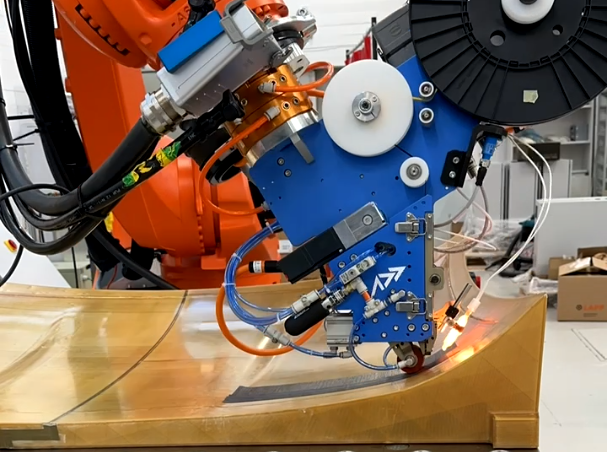
An Addcomposites AFP-XS head depositing carbon fiber tow onto a curved mold, with the compaction and heating zone visible at the nip point. What changes most between CFRP's many space roles is the layup — fiber orientation, local thickness, and ply transitions — which is where automated fiber placement earns its keep.
Our perspective (Addcomposites)
The breadth of CFRP across this map is, for us, the signal worth dwelling on. The same fiber system shows up in primary load paths, deployable mechanisms, shielding, and thermal management. What changes between those jobs is largely the layup — fiber orientation, local thickness, and ply transitions — rather than the base material. That is the regime where automated fiber placement earns its keep, because consistent orientation control is what lets one material serve very different structural roles. To be clear, this is our commentary; the review does not name AFP or evaluate any specific manufacturing vendor.
Mechanical response: damping, properties, and impact survival
The review splits mechanical behaviour into static loads (driven by gravity) and dynamic loads — the latter grouping fatigue, repeated high-strain-rate events, vibration and impact — and observes that the dynamic side has drawn most of the published attention.
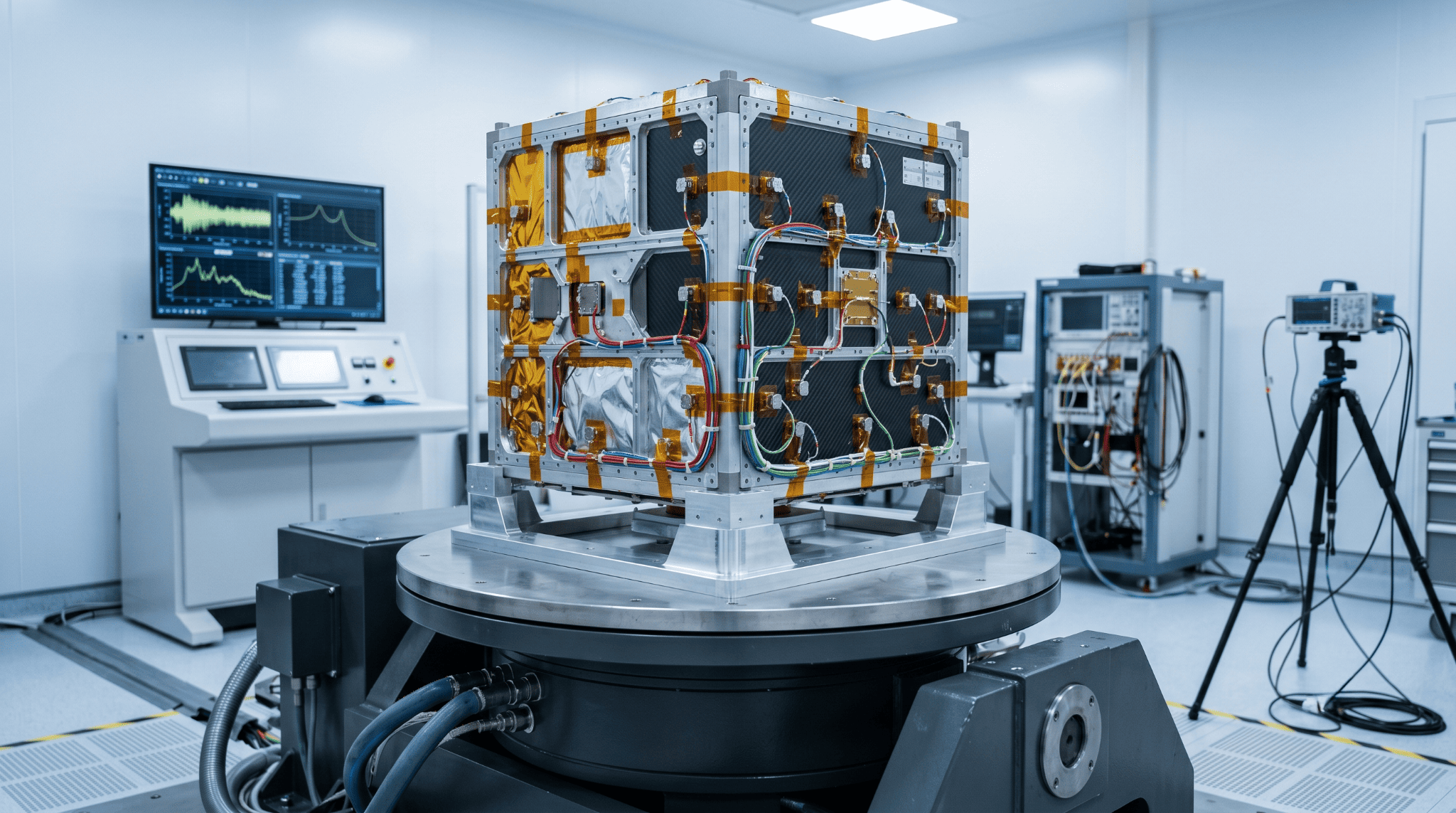
A satellite structure mounted on an electrodynamic shaker table during vibration qualification testing, with accelerometers and sensor wiring distributed across its carbon-fiber composite panels. Dynamic loads such as launch vibration are where most published research on space composites has concentrated. AI-generated illustration.
Vibration and damping
On vibration and damping, the authors describe only a handful of studies. Among them, the paper reports that Cao et al. analysed how a spacecraft's flexible composite drive shaft and its attached solar panels vibrate together, with their method agreeing to within about 4% on the higher-order modes — though, as the review observes, this was checked only on a simplified 1D-shaft / 2D-panel model, so broader use still needs testing.
On mechanical properties, the paper rounds up both characterisation studies and hybrid-material developments. A few of the quantitative results it documents:
Selected Mechanical & Material Findings
As reported by Tserpes & Sioutis, Aerospace 2025, 12, 215
From fluorinated CF before a 500 kGy irradiation dose
Radiation · TensilePolyimide aerogel: 0.85 MPa compressive strength, 3.93 MPa compressive modulus
Aerogel · Compression0.4% MWCNT addition lifted CFRP thermal and electrical conductivity
MWCNT · MultifunctionalAlkylated reduced graphene oxide raised tensile modulus
rGO · ModulusSilicon nitride coating (±53 nm) deposited on CF/PPS composite
Coating · CF/PPSThe authors also point to friction-and-wear research where carbon/polyimide held its behaviour fairly steady under simulated space irradiation, and to a self-lubrication study that singled out a PTFE blend (10% MoS₂, 25% glass fibers) as the front-runner to take over from today's self-lubricating bearing materials.
Hypervelocity impact — damage from debris or micro-meteoroids — gets its own section, and the review is candid that only a thin body of work exists on it so far. The studies it summarises tested composite bumpers across a range of velocities:
Hypervelocity Impact Test Velocities
Per studies cited in Tserpes & Sioutis, Aerospace 2025, 12, 215
2.7–3.3 km/s
3 km/s
5 km/s
7 km/s
TiB₂-based composite bumpers broke incoming projectiles into finer debris than aluminium shields
Composite bumpers outperformed pure-metal shields in inflatable-structure tests
CNT addition raised impact toughness of CFRP composite by 2.5–3%
The review additionally points to a stealth-oriented shield combining hypervelocity protection with microwave absorption, which the authors report performed comparably to an aramid/epoxy baseline while absorbing across roughly 6.65 GHz to 18 GHz.
Thermal, electrical, and radiation behaviour
The thermal section gathers work on protection systems, heat storage, and conductive housings. One result the review highlights: a pitch-based CFRP electronic housing, built with an out-of-autoclave process, that the authors report ran roughly 23% lighter than its aluminium equivalent while still moving heat efficiently (Martins et al.). The paper also flags a ceramic/glass-matrix line of work that puts these materials forward as strong space candidates — valued for holding their shape, tolerating damage, and absorbing sudden temperature shocks.
On the electrical, electromagnetic, and radiation-shielding front, the review again separates conventional-material characterisation from new hybrid proposals. Several shielding results it documents are worth putting side by side:
Radiation & Shielding Results
As summarised in Tserpes & Sioutis, Aerospace 2025, 12, 215
Shielded more effectively than an aluminium baseline
Radiation · CF/PEEKRadiation dose reduction with weight reduction vs current technology
Shielding · MassDose cut at small areal density, rising to 10–15% above 50 g/cm²
B₄C · Areal densityAll three properties improved vs pristine GFRP
GNP · MultimetricResistivity dropped 40% under heat + low pressure; up to 58% under simulated sunlight
CNT · ResistivityThe authors also describe an oxidation-resistance study in which diboride composites with tantalum disilicide held up to 2170 K — yet the same study concluded the material would not cope with the demands of fast atmospheric re-entry, a useful reminder that a headline temperature alone does not qualify a material for every space duty.
How composites age in orbit
One of the most grounding parts of the review is its treatment of long-duration degradation, because it draws on actual flight exposure rather than only ground simulation. The paper lays out a spread of exposure durations:
Exposure Durations in Aging Studies
Per studies cited in Tserpes & Sioutis, Aerospace 2025, 12, 215
Flexural rigidity and modulus reduced by 5–10% after first exposure
Total simulated AO fluence of 3.82×10²⁰ atom/cm² — equivalent to 43 days in low Earth orbit
Real-space exposure on a spacecraft — representing long-duration in-orbit aging
According to the authors, what altered the material most over the long flight study was not impact damage but the resin's slow continued curing in orbit, which carried mechanical consequences of its own. Separately, the review reports that simulated atomic oxygen at early-orbit levels ate into the surface and dragged down flexural performance, while pairing electron radiation with thermal cycling broke the resin down — bonds splitting, others over-linking, and micro-cracks forming. The throughline: it is the matrix, not the fiber, that usually takes the slow damage in space.
Advanced composites: shape memory, self-healing, and embedded sensing
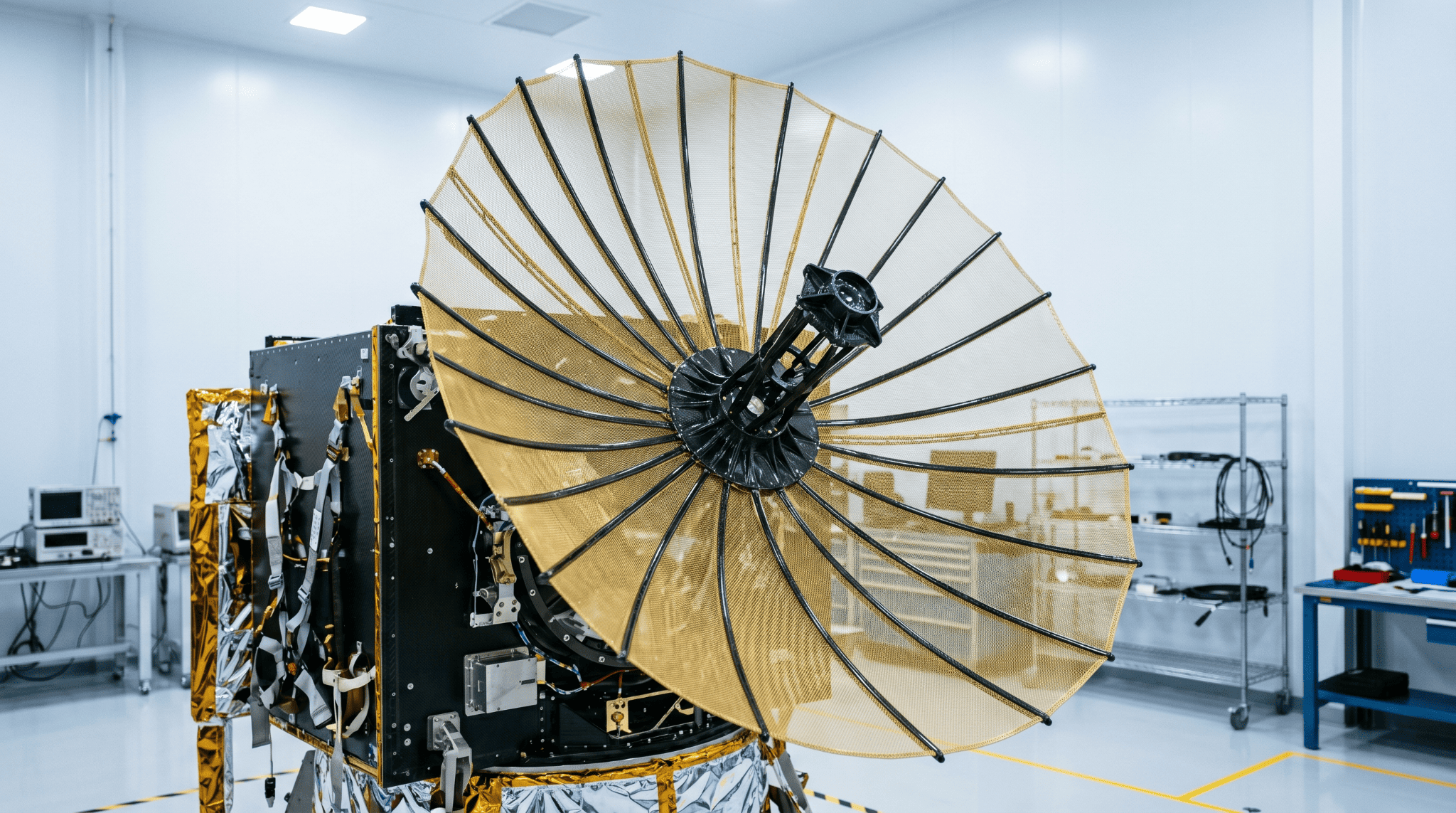
A deployed mesh reflector antenna, its gold reflective mesh stretched over slender carbon-fiber composite ribs that fan from a central hub. Reflectors like this fold for launch and expand in orbit, the kind of reconfigurable structure shape-memory and smart composites aim to enable. AI-generated illustration.
"Smart" behaviour
The review devotes a full section to "smart" behaviour, which is where some of the most forward-looking work sits.
For shape-memory composites, the authors report a composite that recovered as much as a tenth of its deformation across temperature swings — enough, in their framing, to make reconfigurable space hardware a realistic goal.
For shape-memory composites, the authors report a composite that recovered as much as a tenth of its deformation across temperature swings — enough, in their framing, to make reconfigurable space hardware a realistic goal — alongside work on shape-memory antenna reflectors and a carbon-resistive-heating actuator that, in an aluminium-coated form, the review says deployed faster while drawing 24% less electrical power. A flight study on the MISSE-FF platform retrieved samples after a year in low Earth orbit and found that sample orientation strongly affected shape recovery.
For self-healing, the review is measured: it notes that a published self-healing review exists but that much of the surveyed work does not actually relate to space. The clearest space-relevant example it describes embedded healing microcapsules and single-walled carbon nanotubes into CFRP, then subjected specimens to hypervelocity impact, with the nanotubes reported as central to both mechanical reinforcement and the healing process.
For smart / sensorized composites, the paper covers piezoelectric transducers built into the laminate for on-board ultrasonic damage checks, plus graphite-PDMS sensing elements that read micro-strain and temperature from resistance changes. With just three articles falling into this bucket, the authors underline how young the field still is.
Deployable structures and the computational gap
Deployable structures — booms, antennas, solar arrays, and habitats that fold for launch and expand in orbit — get the review's most active treatment, and the authors describe activity in this area as having picked up sharply of late. The studies they summarise span multifunctional hinges with integrated piezoelectric actuation, deployable telescope dynamics, ultra-thin shell booms analysed with the Carrera Unified Formulation, anisogrid lattice reflector spokes, deployable habitat cabins, and machine-learning-driven optimisation of bistable C-section structures for roll-out solar arrays.
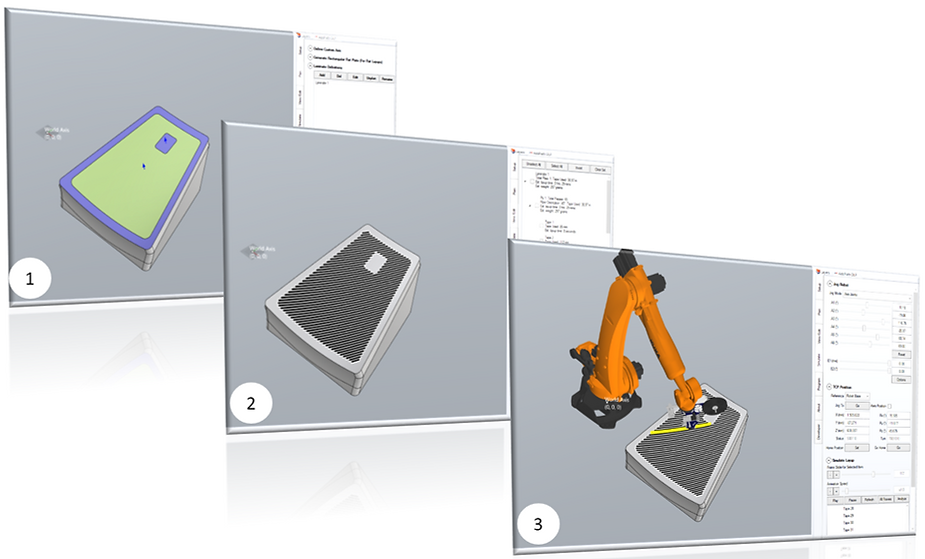
AddPath simulating fiber placement on a composite part: defining the surface, generating fiber paths across the geometry, then verifying the robot motion before anything is manufactured. Simulation-driven design like this is exactly what the review argues space composites still need more of.
That last point connects to the review's most pointed observation. In its computational models section, the authors argue that modelling has reached space composites far less than it has aircraft composites, and that most of the work done so far sits in one place: the dynamics of deployable hardware. Effects such as rain erosion, debris strikes and atomic-oxygen attack, they note, still resist clean mathematical or simulation treatment. In their conclusions, they single out modelling paired with artificial intelligence as a promising way to design the next wave of composites through simulation rather than trial and error.
The three challenges that will define the next decade
Pulling the conclusions together, the review is direct about where current composites still fall short. The authors state that, for all the property gains achieved, today's composites still turn brittle and lose strength at cryogenic temperatures and degrade when hot, and that these weaknesses bite hardest in large-volume parts. They also observe that the open literature is thinner than the activity would suggest, in part because a good deal of the work happens inside government or partner space programmes that keep results from public release.
Reading across the survey, three design challenges recur as the open frontier:
Our perspective (Addcomposites)
Each of these challenges is, at root, a fiber-architecture problem. Near-zero CTE depends on precise, balanced laminate design. Resilience against microcracking depends on consistent ply quality and orientation through complex geometries. Multifunctional integration depends on placing functional plies, sensors, or conductive paths exactly where the design calls for them, ply by ply. Automated fiber placement is the manufacturing route that turns those design intents into repeatable hardware, and our AFP systems (AFP-XS, AFP-X, ADDX) together with our AddPath software are built around exactly that kind of orientation control. We offer this as our own engineering view of where the manufacturing leverage sits. The review by Tserpes and Sioutis does not endorse Addcomposites, name AFP, or evaluate any specific product, and nothing here should be read as their recommendation.
Why this review is worth your time
In our view, what makes the Tserpes and Sioutis review valuable is its honesty. It does not oversell composites for space. It maps where CFRP and its relatives are genuinely winning, documents the quantitative gains with sources attached, and then says plainly where the materials still struggle and where the modelling tools have not caught up. For teams positioning composite capability for space programs — satellite structures, launch airframes, deployables, payload supports — it is one of the few current references that lets you see the whole field and the open problems at once.
From our side at Addcomposites: if you are weighing composite manufacturing strategy against the challenges this review identifies, that landscape is exactly the conversation we have with customers every day. But the place to start is the source itself.
Learn More
Get in touch to discuss your composite manufacturing strategy →
Contact Us for a ConsultationRead the Research
- Tserpes, K.; Sioutis, I. "Advances in Composite Materials for Space Applications: A Comprehensive Literature Review." Aerospace 2025, 12, 215. https://doi.org/10.3390/aerospace12030215
Open access, published 7 March 2025 by MDPI under the Creative Commons Attribution (CC BY 4.0) license (https://creativecommons.org/licenses/by/4.0/). All data, findings, and figures referenced above are the work of the original authors.
