CFRP Wins the Weight Argument in Defense Armor. Radar Signature Is Where It Needs a Plan.

A 2025 open-access review is a useful reminder that weight is only one of the arguments for carbon fiber in defense armor — and that on radar-critical programs, the very property that makes it structurally attractive is also the one that has to be engineered around, deliberately and early, rather than assumed away.
If you manufacture carbon-fiber structures for defense programs, you have probably built your pitch around one number: weight saved. It is a good number. But it is not the only argument, and on the programs where it matters most, it is not even the deciding one.
The review is Fiber-reinforced polymer matrix composites for improved defence armor — A comprehensive review by Nilesh S. Gaikwad, Dhiraj D. Deshmukh, and Sachin P. Kakade, published in Smart Materials in Manufacturing (KeAi / Elsevier), 2025. It surveys how fiber-reinforced polymer (FRP) composites — carbon, aramid, glass, and ultra-high-molecular-weight polyethylene (UHMWPE) — are being used across modern defense armor, from personal ballistic protection to vehicle and airframe structures. Below we walk through what the paper establishes, add current context from the wider stealth-materials literature, and then give our own read on what it means for anyone running an automated fiber placement (AFP) shop bidding on defense structural work.
A note on scope: everything attributed to “the paper” or “the authors” below comes from Gaikwad et al. (2025). Sections marked “Our perspective” are Addcomposites' own editorial analysis and are not drawn from, or endorsed by, the paper's authors.
What the review actually covers
The paper is a broad survey rather than a single experiment. According to the authors, it pulls together the material families used in ballistic protection, the manufacturing routes used to build them, the physics of how a projectile is stopped, the standardized tests used to certify armor, and a forward look at where defense composites are heading. Its recurring theme is that ballistic performance is never a property of the fiber alone — it comes out of how several variables interact: which fiber and matrix, how they're laid up and how thick, the shape and speed of what strikes them, and the panel's mass per unit area.
That framing matters, because it is exactly the layer where AFP shops operate: not choosing between “carbon or aramid” in the abstract, but deciding how a specific fiber is placed, oriented, and consolidated into a specific part.
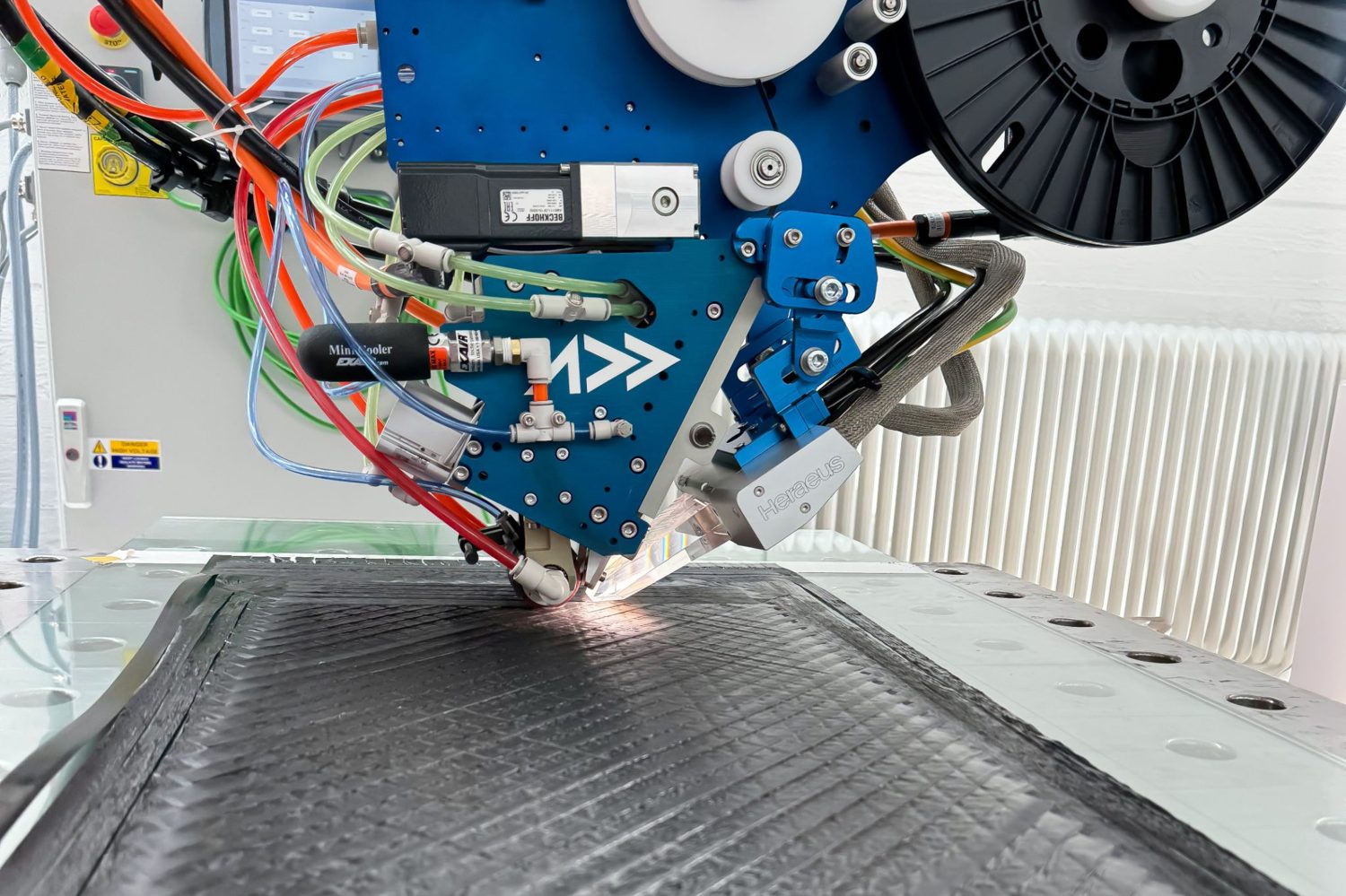
Automated fiber placement in action: an Addcomposites AFP-XS toolhead places, orients, and consolidates carbon-fiber tow onto the part in a single pass — the layup layer where structural performance is decided. Photo: Addcomposites.
The weight argument, where CFRP is strongest
The paper's data on fiber properties is the clearest place to see why carbon fiber earns its reputation. Drawing on the mechanical-property comparison the authors compiled, here is how the leading ballistic and structural fibers stack up on the three numbers that drive an armor material selection — tensile strength, stiffness, and density.
Table 1 — Gaikwad et al., 2025
Fiber property comparison
Carbon leads on raw strength and stiffness; UHMWPE wins on density (lowest mass); glass is the heaviest of the four.
Ranges reported by Gaikwad et al., 2025, Table 1.
The authors report tensile strengths north of 3,500 MPa for advanced CFRPs, with the finished composite's density reaching as low as ~1.6 g/cm³ — lower than the 1.75–2.0 g/cm³ of the bare carbon fiber in the table above, because the epoxy matrix is lighter — the pairing that lets them outperform aluminium and steel once you normalize for weight. The paper also reports that FRP composites can cut structural mass by up to roughly 30% versus comparable natural-fiber composites, and that this weight advantage is what makes composites attractive for the parts of a defense platform where mobility and payload are the constraint: UAV airframes, vehicle structures, and aircraft components.
This is the market where the AFP value proposition is cleanest. When the deciding factor is “how much structural mass can we remove without losing stiffness,” carbon fiber placed by AFP is a strong answer, and the conversation with a defense customer is straightforward.
The ballistic nuance: strong is not the same as stop-a-bullet
Here is where the paper complicates the story, and it is worth reading carefully. The authors point out that carbon-fiber composites, despite having the highest strength and stiffness of the four fibers above, do not automatically win at stopping projectiles. The reason is failure mode. Carbon composites tend to fail in a brittle way, so they can register lower ballistic-limit velocities than tougher, more energy-absorbing fibers.
The paper expresses this through V50 — the velocity at which a projectile has a 50% chance of perforating the target. The reported ranges tell the story:
V50 ballistic limit — Gaikwad et al., 2025
Higher V50 = harder to perforate
Carbon sits lowest here despite topping the strength/stiffness chart above — it fractures rather than stretches.
Aramid + UHMWPE hybrid — adds roughly 10–15% over a single-fiber baseline (synergistic; shifts the band upward).
Values reported by Gaikwad et al., 2025.
The authors put standard-threat V50 at roughly 400–600 m/s for aramid and 500–700 m/s for UHMWPE, crediting UHMWPE's edge to how much energy its high-specific-strength fibers can soak up; carbon composites sit lower, around 300–500 m/s, because they tend to fracture rather than stretch. Pairing the two fibers buys another 10–15% in V50 over what either delivers alone.
The paper is careful to describe the mechanism behind these numbers. On impact, the fibers directly under the projectile take a mix of compression, shear, and bending; from there the energy bleeds off through several failure routes at once — fibers snapping, the matrix cracking, plies separating, fibers dragging free of the resin, and the fiber–matrix bond letting go. Delamination sounds like damage, but it does useful work: by letting plies separate, it channels energy sideways between layers instead of straight through, which lowers the odds of a clean perforation. Below is that energy-dissipation chain as the authors describe it.
Ballistic energy dissipation chain
As described by Gaikwad et al., 2025
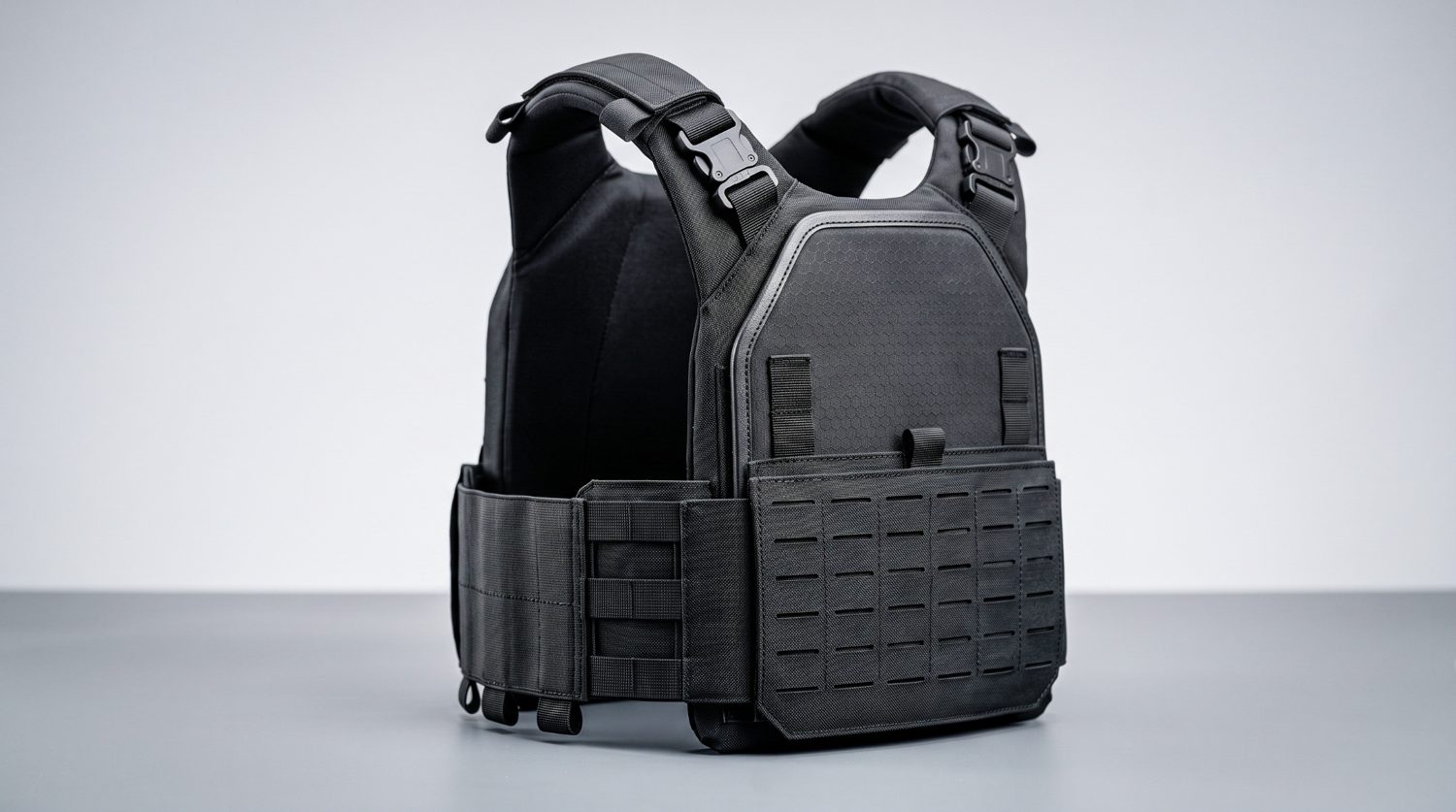
A modern composite plate carrier. Body armor is a multi-material stack — a hard ceramic strike face and aramid or polyethylene layers absorb and defeat the projectile, while stiff, lightweight carbon-fiber structure does the backing and load-bearing work. The paper's point is that these roles are split, not carried by any one fiber.
For AFP shops, the practical read is that carbon is a structural armor answer more than a stand-alone ballistic answer. In real systems the two roles are usually split — ceramic or aramid/UHMWPE handles the strike face and energy absorption, while carbon does the stiff, lightweight backing or surrounding structure. That is a natural fit for AFP-XS on the structural components, and it reframes the customer conversation away from “is carbon bulletproof” toward “where in this multi-material stack does carbon belong.”
The stealth argument, where CFRP creates program risk
This is the part of the review most relevant to the blog's headline, and it deserves the most care because the physics cuts against the marketing.

The paper points to stealth as another composite frontier, citing India's development of RAM that combines carbon-nanotube and conductive-polymer chemistries to lower the radar signature of aircraft and ships, and framing this as one of the ways composites have reshaped modern defense. But the review also treats stealth as a managed property — something engineered in with RAM and hybrid architectures, not a free benefit of using carbon.
The wider stealth-materials literature makes the underlying tension explicit, and it is worth bringing in here. A structural carbon-fabric skin is electrically conductive, and a conductive surface tends to reflect incident radar waves straight back toward the receiver rather than absorbing them. A 2018 review in the Journal of Applied Polymer Science (Wiley) put it plainly: for stealthy structures, plain carbon fabric is limited precisely because its conductivity reflects radar energy back to the source. In other words, the same conductivity that makes carbon useful for lightning-strike current paths works against you when the goal is to disappear from radar.
The nuance — and it is a genuine nuance, not a loophole — is that carbon in filler form is a completely different story. A 2023 review in Advanced Science (Kim et al.) surveys carbon-based radar-absorbing materials — carbon black, carbon fibers, carbon nanotubes, graphite, graphene, and MXene — and shows that when carbon is tuned as an absorber inside a multilayer stack, it becomes one of the best lightweight RAM options available. Researchers have reported that carbon nanotubes reach the same conductivity at roughly 0.35% loading that carbon black needs about 20% loading to hit, which is why CNTs are attractive for thin absorbing layers. And in 2025, an NC State team described a CNT-reinforced carbon-fiber composite skin that conducts incoming electromagnetic energy and tolerates temperatures well beyond what conventional RAM coatings survive, aiming to fix the heat and durability limits of paint-on RAM used on aircraft like the B-2.
So the honest picture is not “carbon is bad for stealth.” It is this:
Addcomposites editorial synthesis
Where CFRP fits by program type
Rule of thumb: the more the platform's success depends on a low radar signature, the more “structural CFRP” must be paired with a signature strategy that is decided at design time, not bolted on late.
This is the expensive surprise to avoid. If a defense customer is building a radar-sensitive platform and treats the CFRP structure and the radar treatment as separate, late-stage line items, the absorbing architecture can end up fighting the structural laminate for thickness, weight, and cure compatibility. Surfacing that dependency during the structural bid — before qualification — is a small conversation that prevents a large redesign.
Manufacturing and cost, the two barriers the paper keeps returning to
The review is candid that performance is not the only variable. According to the authors, high material cost and end-of-life recyclability are the two persistent adoption barriers for lightweight composites across defense procurement, regardless of application.
On cost, the paper puts real numbers on the manufacturing routes. The authors put autoclave processing at roughly $50–100/kg — the premium route for laminate quality — against about $20–40/kg for resin transfer molding, which scales more easily. On raw fiber, they cite aramid at roughly $30–50/kg and UHMWPE at roughly $50–80/kg. The paper's argument is that lifecycle thinking — factoring in durability and the savings that come with lower mass — can offset a chunk of that premium over time, on the order of 20–30%.
Gaikwad et al., 2025
Manufacturing route cost (approx, per kg)
On recyclability, the authors point to three recovery routes — grinding the composite down mechanically, breaking the matrix thermally, or dissolving it chemically — with the thermal route, run at 400–700 °C, returning carbon fiber at close to 90% of its as-new strength. The paper frames sustainability not as a nice-to-have but as part of the procurement calculus.
The cost gap between autoclave and out-of-autoclave routes is one of the strongest arguments for automating layup. AFP does not by itself pick a cure route, but placing fiber precisely and repeatably is what makes lower-cost, high-throughput consolidation viable at defense qualification standards — which is where the lifecycle math the authors describe starts to actually pay off.
Market context
The paper reports armor-material market figures drawn from a 2024 industry report, showing growth from about $12.3 billion in 2023 toward roughly $16.87 billion by 2028 at a compound annual growth rate near 6.3%.
Report cited in Gaikwad et al., 2025
Armor materials market (USD billion)
CAGR ≈ 6.3%
For current context, independent 2025–2026 forecasts land in a broadly similar zone but vary by scope: Mordor Intelligence pegs the armor-materials market near $15.5 billion in 2026 growing at roughly 6.9% CAGR to 2031, while Market Research Future estimates about $13–14 billion in 2024–2025 at a 6.8% CAGR. The exact totals differ with methodology, but the direction is consistent — mid-single-digit annual growth, with ceramics-and-composites among the faster-moving segments and lightweight hybrids specifically called out as a demand driver.
Where Addcomposites fits
This section is Addcomposites' own positioning and is independent of the paper.
The through-line of the review, for a manufacturer, is that armor is a multi-material, layup-dependent problem — and layup is precisely what automated fiber placement controls. A few practical connections:
- AFP-XS is our flagship compact, plug-and-play AFP toolhead: it turns a standard industrial robot into an automated fiber placement system, aimed at R&D and small-to-mid-scale production — which is where most defense structural CFRP work starts, and where repeatable fiber orientation drives both mass and stiffness.
- AFP-X is our four-tow system built for higher throughput and high-volume production across large surfaces — for when you have outgrown what a single-tow cell can turn out.
- AddPath is where the orientation decisions the paper keeps pointing to — laying 0°/90° stacks to spread multidirectional impact loads, or angling plies where shear is the priority — get programmed deterministically rather than left to hand-layup variability.
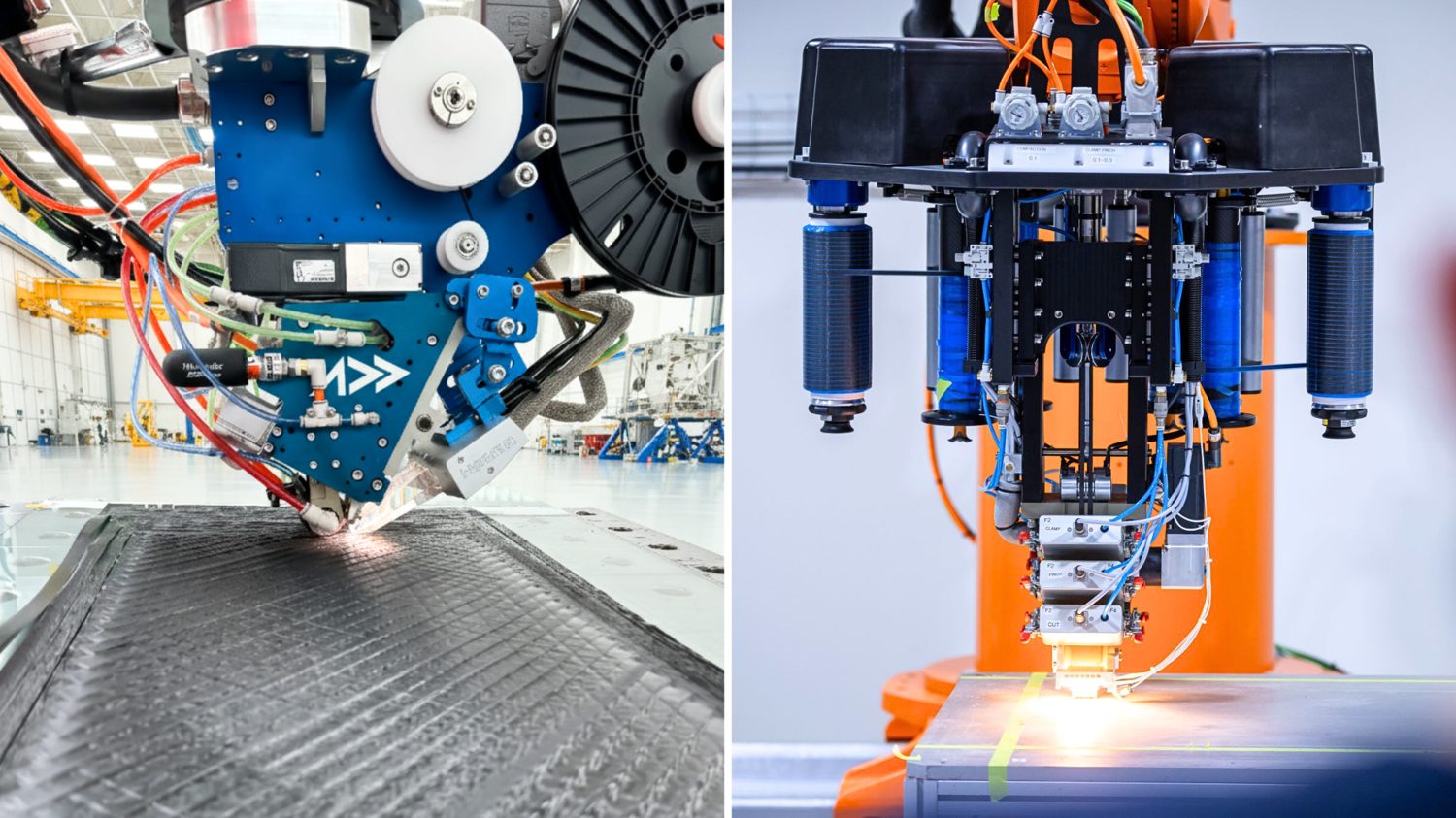
Left: the AFP-XS, a compact single-tow head that turns a standard robot into an AFP system — the entry point for defense structural CFRP. Right: the AFP-X, a four-tow head for higher throughput on large surfaces. Both place, orient, and consolidate fiber deterministically. Photos: Addcomposites.

Planning a layup in AddPath: ply sequence and fiber orientation are programmed offline and deterministically — before a single tow is laid, not left to hand-layup variability. Screenshot: Addcomposites.
The stealth section above is the one we would flag hardest to any team bidding structural CFRP into a radar-relevant platform: AFP gives you a clean, repeatable structural laminate, but a bare conductive CFRP skin is not a signature solution. Deciding early whether an absorbing architecture rides on top of, or is co-designed with, the AFP-manufactured structure is the difference between a smooth qualification and a late one.
Our perspective, in one line
Carbon fiber's weight advantage is real and, for structural defense parts, often decisive — but the review is a useful reminder that “stronger” is not “harder to perforate,” and “conductive” is not “stealthy.” The manufacturers who win defense structural work are the ones who know exactly which argument they are actually winning on each program.
Read the Research
- Gaikwad, N.S.; Deshmukh, D.D.; Kakade, S.P. “Fiber-reinforced polymer matrix composites for improved defence armor — A comprehensive review.” Smart Materials in Manufacturing 3 (2025) 100084. doi.org/10.1016/j.smmf.2025.100084. Open access under the Creative Commons Attribution Non-Commercial No-Derivatives (CC BY-NC-ND 4.0) license (creativecommons.org/licenses/by-nc-nd/4.0/).
- A 2018 review in the Journal of Applied Polymer Science (Wiley), cited for the limits of plain conductive carbon fabric in stealth structures.
- Kim et al., Advanced Science (2023) — review of carbon-based radar-absorbing materials (carbon black, carbon fibers, carbon nanotubes, graphite, graphene, MXene).
- Reporting via the American Composites Manufacturers Association (2025) on an NC State CNT-reinforced carbon-fiber composite skin for radar-absorbing, high-temperature-tolerant aircraft structures.
- 2025–2026 armor-materials market forecasts from Mordor Intelligence and Market Research Future, cited for current context alongside the figures reported in ref. 1.
This article is an independent editorial summary and commentary produced by Addcomposites. It is not affiliated with, reviewed by, or endorsed by the study's authors or their institutions. The supporting stealth and market sources are separately published works, named inline above; none were reviewed or endorsed by Addcomposites. Infographics are our own visualisations of data tabulated or reported in ref. 1, and are not reproductions of any figure from the paper.
